Sunday, September 4, 2011

All The Young Monx

Like a French provincial town transplanted to tropical paradise, Luang Prabang sits nestled between the Mekong and Nam Kam rivers in north-central Laos, about 475km. north of the capital Vientiane. After walking the jungle and tasting rural and small town life in northern Laos, we step into the "big" city (all of about 100,000 people) to find all the comforts of home--or at least those of Thailand. Modern coffee shops, bakeries, diverse cuisine...and unsurprisingly a bevy of Western tourists. Fortunately they haven't quite yet ruined the charm of Luang Prabang.

Luang Prabang's status as a UNESCO World Heritage Site has helped to preserve the crumbling, French-influenced architecture that lines the city's streets. It also allows the local government to ban trucks and buses from barreling down the main streets, a welcome break for any traveler using their feet as a main means of transport. The city is teeming with young monks walking in small groups to and from the many temples and monasteries, tucked under matching orange umbrellas and smiling gently as we cross paths. We find it all fairly charming, the slow pace and friendly people adding to the relaxing atmosphere.


Monk laundry.
Every night the main street shuts off traffic and fills with a market brimming with souvenirs. It's a great place for a slow wander and a snack. We manage to find the vegetarian food stalls on a side street off the market, where for 10-12,000kip (about $1.50) you can load your plate with an assortment of veg and tofu goodies. The quality is nothing stellar, but its good for a quick, cheap meal. 

The Lao have this great saying: "Same, same...but different!" and it perfectly encapsulates many of the goodies on offer at this market. Little old ladies, many from nearby tribes, one after another, selling the same t-shirts, trinkets and sarongs as the next one down the line. But we still manage to find a few gems--some little bottles of locally made Lao Lao whiskey for me and a cute dress for Sadrah that she negoitated down to a fair price.


It rains quite a bit over our first few days in town, so we take it easy--get some laundry done, chill out over coffees and pastries, poke into shops and visit a few temples between the raindrops. 

Making paper.
Weaving.
When the weather finally breaks we rent bicycles and venture out of the city into some of the smaller villages where women weave silk garments for the night market stalls on giant looms. An older woman is kind enough to let us into her home for a few moments to observe the lengthy, tedious process. She and her friends speak no English, but the kindness in their smiles is more than enough communication. Later we stumble upon a collection of shops selling handmade paper products. We stop for a minute to watch a women making paper by hand.

We also enjoyed some great meals in Luang Prabang. Twice we were stuffed to the gills with Lao barbeque, a do-it-yourself tabletop feast. The waiter removes a tile from the center of our table and places a stone bucket of hot coals in its place. On top he sets a metal dish. In the raised center we grill slices of tofu while around the edges we pour a soup broth and fill it with tons of fresh vegetables and noodles to cook. We add garlic and chilies to the broth, and coat the tofu slices in a tangy barbecue sauce. In the end it's more than enough food for at least 3 people, probably more. At 50-60,000 kip for a massive meal, it's a great value.

Lao barbecue.
We had another dinner at a great restaurant called Tamarind (which offers training and education in hospitality and restaurants for street children) where we were able to sample some of the traditional local specialties. It can be tough to eat like a local in these parts when sticking to a vegetarian diet, but the sampler platter and meuyang (a wrap-your-own mix of noodles, herbs, pastes & vegetables) turned us on to some great flavor combinations. It was definitely a "classy" night out for our budget, but it's worth the splurge every once in a while to try out some really tasty food and support a good cause!


On our last day we organize a ride to Kuang Su Waterfall about 30km. outside of the city.  We take a few hours to explore the crashing falls at the top and several pools that form below that are great for swimming.  We even try out the rope swing.

Every morning just before sunrise, in every village and town in Laos, monks leave their temples to collect alms from the local people. With the number of temples concentrated in this small city, the sheer volume of monks is quite striking. Hundreds of monks fill the streets, each carrying a basket which the local people along the street fill with a handful of sticky rice each. Although it seems a bit like charity, they give alms as a way of gaining merit in their faith. "It is closer to a symbolic connection to the spiritual and to show humbleness and respect in the presence of normal society. The visible presence of monks and nuns is a stabilizing influence. The act of alms giving assists in connecting the human to the monk or nun and what he/she represents." I stole that from Wikipedia, but it was the easiest way to describe the ritual.


Unfortunately the photo-op has become quite a tourist draw, as the streets teem with barefoot monks in dark orange robes walking in silent procession in the light of daybreak. Thankfully, the government has gone to great lengths to make sure that  tourists are observing the ritual respectfully. On our last morning in town we rise in complete darkness and head for the main road near our guest house. We make sure to keep our distance, observing as men and women emerge from their homes with big baskets of sticky rice and kneel on mats along the sidewalk. Soon rows of monks appear out of the darkness, seeming to come from all directions.  They collect their daily alms in a barefoot procession silent but for the soft padding of hundreds of feet, and the whole ritual is over in a little over 20 minutes. 

Sunday, August 21, 2011

Slow ride, take it easy

There are several ways to make the long journey south from the more remote regions in the north to the cities of Laung Prabang and Vientiene in central Laos.  Trapped on a bus, fearing for your life on a speed boat...hitchhiking perhaps? Take your pick. But one of the most popular modes of a transport is a "slow boat" ride down the Mekong River.  Two lazy days drifting down the river sounded pretty good to us, and although we'd heard mixed reviews on the experience, but we decided to give it a go anyway.

Day one starts in Huay Xai with an early breakfast and transport to the boat launch at the north end of town. We hop aboard one of many large longtail boat along the shoreline and settle into a couple repurposed bus seats (always the inventive recyclers!) near the front of the boat as our packs are stored below deck. In typical Lao fashion we hang around for another hour so, periodically loading new passengers until all the seats are full.

The boat is pretty simple but functional: four seats wide, with two on each side of a reasonable isle down the middle. At the front of the boat there's a small enclosure for the captain and at the back a small "shop" for snacks and a clean enough bathroom.

Photo hijack.
We'd heard rumors of a party boat-ish atmosphere, and although the boat is filled with mostly twenty-something backpackers, they're hardly rowdy. A few beers are downed here and there by some, but generally the ride turns out to be a peaceful, relaxing affair. The scenery is gorgeous and the fresh, exhaustless air is more than welcome in our lungs. It's also nice to be able to get up and stretch your legs or use the bathroom whenever you feel like it, unlike a typical bus ride.

(Later, in Luang Prabang we cross paths with the four girls from Norway who were with us on The Gibbon Experience. They decided to take the bus from Huay Xai to Luang Prabang, which turned out to be a joyous, 17+ hour journey.  Their trip included: two flat tires, getting out to help push the bus and late night mosquito attacks. Not to mention the hour the driver spent teaching his protege how to park the bus on the side of the road. Needless to say, we're certainly glad we opted for the boat.)

riverside 7-11
The two day trip is broken up with a night spent in the small riverside town of Pak Beng. Essentially a small, rural village, any tourist industry here has sprung up solely around the daily deposit of slow boat passengers and their basic needs.  You know, the basics: snacks, western breakfasts, drinks, drugs...maybe even a place to sleep for a few hours.  Before our bags are even off the boat we're assaulted by all manner of salesmen touting their guesthouses, and more importantly their ability to procure you marijuana.  We manage to slip away and wander along the main road until we find a tolerable room for the night.  It was a bit dingy, but at least it was only 40,000 kip (8000 kip = $1) for the night.

Views from the boat.
With our new friend Fran, a sweet middle-aged teacher from France who took the room next to ours, we wander the streets for an hour or so, chatting and exploring past the guesthouses to catch a glimpse of real life in this riverside village. Most of the homes in Laos have a very wide, open floor plan, so it's often possible to sneak a peek at the going's on around the home.  Sometimes the little moments you glimpse in this way are the most interesting of the day.  After our walk we grab a nice dinner with Fran at an Indian restaurant and then head for bed.

Did I mention our boat was also a submarine?
In the morning it's breakfast and back on the boat by 9AM.  The 2nd day's boat is a bit smaller and considerably more cramped.  Especially for the hungover late-comers to the pier who are forced to sit in the very back of the boat, nearly on top of the roaring engine.  For us it's just fine--we grab two seats up front, and aside from a bit of rain the trip feels rather short and sweet.  We arrive in Luang Prabang around 4PM with no place to stay.  Bags strapped to our backs, giant, attention-grabbing travel guidebook in hand, and sun blaring down on us we set out to find a place to lay our heads.  You know, just another typical day...

Wednesday, August 10, 2011

We go zip!

After an extra day in rainy, gray Huay Xai to recharge our batteries and update the blog--which is, incidentally, several weeks behind--we head out with a small group on The Gibbon Experience. As part of a conservation project in Bokeo National Reserve in northwest Laos, The Gibbon Experience bills itself as a great example of responsible ecotourism. The guides are all from local villages in or around the reserve, and A good portion of the income generated by our trip goes toward reforestation projects (many of the local farmers still practice slash and burn agriculture which is terribly inefficient and leads to erosion) and protecting the forest wildlife from poachers. The namesake of our adventure is a monkey that lives mostly in the forest canopy, swinging great distances from tree to tree in search of a life-long mate.


In keeping with the gibbon's airborne, treetop existence, we spend the bulk of our two days riding zip lines high above the forest canopy and trekking through dense jungle. It's both breath-taking and exhausting, with some zip lines crossing 6-700 meters from one high point on the ridge to another.

All geared up.


Zipping to the tree house.

In the mid-afternoon of the first day we reach our accommodation for the night--a three-story tree house built 200ft. up around a massive old tree. The tree house is beautiful, comfortably sleeps eight people with soft mattresses, warm blankets and mosquito nets.  It even has running water and electricity! Here, perched above the forest canopy, we have an amazing view of the surrounding landscapes. The bathroom is perhaps the most amazing part of the whole place, with an open 180°+ view of the jungle. It's probably the most beautiful shower I have ever taken.

I spotted a gibbon.


Our tree house suite

After a strenuous morning and afternoon we spend the remainder of the day snacking, relaxing and getting to know our group. Our guides zip a hearty dinner over from a kitchen somewhere on solid ground just as a torrential rainstorm rolls in. For a few moments the winds howl, the rain spits and the tree house sways...but thankfully it's all over rather quickly. After the storm subsides we share a glass of Lao wine with our guides as the darkness settles in and the sounds of the jungle grow in volume and variety.  It was especially fun getting to know our young, energetic guide and teaching him the proper way to use a double-hinged cork screw.  


Gorilla in the mist.

We rise just before 6AM for a morning of zipping around the jungle.  We return to the treehouse briefly to collect our things, down a hearty breakfast and begin our trek back Huay Xai.  After five hours of trekking, zipping and considerable sweating--with a quick lunch thrown in at the hut of a forest guard--we pick up our transport for a bumpy ride out of the jungle.  It's tough to imagine how they ever manage these roads deeper in the wet season. Only in the last hour or so of the trip did the leeches finally show their blood-sucking little faces, but thankfully for us we escaped unscathed.  However I can't say the same for some others in our group. Perhaps it was the Deet in our bug spray?  We heard somewhere that is was good for deterring leeches.


Sticky rice goes with everything.

We return to Huay Xai thoroughly exhausted but completely satisfied with our trip. We check into a guesthouse for one more night and book tickets on the slow boat to Luang Prabang for the morning. A relaxing ride down the mighty Mekong is just what the doctor ordered...


Pai in the sky

From Pun Pun we headed northwest to the hippy/expat enclave of Pai, a small town nestled into the northern mountains. Arriving in the off-season we found Pai to be very quiet and relaxing, but we were assured that a Khao San Rd-like atmosphere explodes in the high season. Lucky for us we missed that. We took it easy for a few days in, enjoying complimentary coffee and bananas from our guesthouse in the mornings, exploring some of the sites & attractions later in the day and lounging in cushiony bars with free mojitos at night.

Thai curry paste
Chef Sadrah
We took an excellent Thai cooking class from a very friendly, extremely thankful woman @ the Red Orchid and finished the day full of knowledge and even fuller of delicious food. First we visited the local morning market to shop for all our ingredients for the day. We were finally able to put some names to mystery vegetables we'd been spotting along our trip so far. Then we learned to cook five different traditional Thai dishes each, including a lesson on how to make Thai curry paste with mortar and pestle. Needless to say it's quite a workout. Thanks again to the low season we were the only two people in the class, so we got lots of personal attention.


Unexpectedly tough ride to the hot springs...on rickety cruiser bikes

Some other highlights: we rented bikes and took in the scenery on the way to visiting some local hot springs, hit up a in-ground pool/bar, sampled some tasty teas, coffees and pastries, wandered the night market along the main road and checked out open mic-night. Perhaps Pai was a bit touristy all and all, but we enjoyed it.

After a few days in Pai we rented a motorbike and made the 45km journey over the mountains to Soppong and Tham Lod Cave. It was rainy and cool at the top, but there were spectacular views of the valleys below. Surprisingly the ride wasn't much of a challenge after our last motorbike jaunt. Sadrah's becoming quite the road hog!

The view from Pai to Soppong
We arrived a few hours later and took a bungalow at The Cave Lodge. A cozy outpost complete with food, lodging and a multitude of tours to offer. Cave Lodge is built into a hillside overlooking the river that runs through the cave and its front door is just a short jaunt from the entrance to Tham Lod.

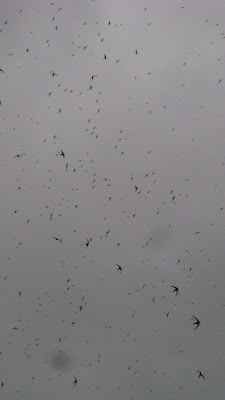
That evening we hiked a short distance to the cave exit for the infamous bird/bat show. Every night hundreds of thousands of swifts fly into the cave to eat and sleep for the night while all the bats fly out of the cave. We witnessed and endless stream of birds circling above the entrance to the cave and then spiraling down and inside for the night. We watched mesmerized for nearly 40 minutes as the steady stream of birds showed no signs of letting up.

BIRDS
The next day we both started to come down with something and opted for the more basic cave tour run by the forestry office down the road from the Cave Lodge. We rode into the cave on a bamboo raft, our guide lighting the way with a kerosene lantern. We visited several caves off the main river which housed huge and varied rock formations, sink holes and mysterious ancient coffins. Even in our sickly state (heightened by the overwhelming ammonia stench of bird/bat guano), and with our guides very basic English (she could only really point out rock formations that look like animals), it was all quite interesting.

After the tour we managed the motorbike ride back to Pai and fought through the fever and nausea to board a late night minibus to Chang Khong, a small Thai town along the Mekong River and the border with Laos.


After what amounted to a very easy and uneventful border crossing the next morning--except for the guy at the border bragging about his photo with Steven Seagal--we found ourselves in Huay Xai, Laos--a bit weary but excited to explore a new country. But first we found a decent guesthouse and slept most of the day away, hoping to recover quickly from whatever ailed us.

Tuesday, August 2, 2011

The Road to Pun Pun

It's possible that we could have happily spent more time in Chiang Mai. It's easy to while away an afternoon strolling the streets and checking out the goodies for sale or plopping down at a curbside cafe sipping on fresh coffee and participating in one of my new favorite activities - monk spotting! But it was time to move along. Thai cooking courses are a very popular activity for Farang visiting Thailand and prior to leaving the States, I sought out an organic farm and vegetarian cooking school located a few hours from Chiang Mai.

We email them about our visit and are informed that the cooking class isn't being offered in the slow season but we are still welcome to come and visit the farm and volunteer in the kitchen to pick up a few tips and pointers. We decide to give it a go--but first we had to find it.

The directions on the website read more like steps in a scavenger hunt. 1.  Find the Warowot market (we opted to take a sweaty walk there rather than a tuk-tuk) 2. Once at the market find the river, turn left and walk 100 meters. 3. You will see a phone booth and a parking lot, walk past the parking lot and turn left down an alley where you will find a row of white trucks 4. Skip three strides then hop twice and you will have arrived.


 In reality it is far easier than the instructions make it sound and we arrive early enough to peruse the market. This is probably the first true local food market we've seen so far on this trip, full of live eels and turtles waiting to become someone's dinner as well as some unlucky frogs on skewers. It seems everything comes on a skewer in Thailand and I have no complaints about that! We pick up some fresh rambutan and passion fruit as well as a few fried bananas before we hop on the truck.

As with most businesses and modes of transport in this part of the world our truck was dual purpose. In addition to carrying us and a few Thai women, our truck also acts as a supply transport making several stops to unload various goods (bicycle and motorbike tires, cases of condensed milk, potted trees) to small villages and homes along the way.


Our ride ends about two hours later on the side of a dusty road. The driver motions us toward a muddy path that puts our balance to the test. We traverse rice paddies and makeshift bridges and feel pretty good about our successes thus far, but when we arrive at the farm there was no one in sight.  We knew that Krit, the man we emailed, would be in Chiang Mai until the next day but were told that other members of the community would be expecting our arrival. We ditch our bags at what looks like the main dining building and go for a walk around the grounds hoping to encounter someone.

All of the buildings are earthen structures, made of some combination of raw wood, bamboo, mud and clay and are in varying states of upkeep.  The paths are a bit overgrown and everything looks slightly neglected.  We poke around a bit and having still encountered no one head back to where we stashed our bags.  Out pops a head with long hair and a longer beard from the previously unnoticed 2nd floor of the main building. His name is Botash and he is from Hungary. He speaks English well and we ask him some questions about the farm but he seems to have about as much info as well do.  We sit with him for a while lounging about and reading a bit, waiting for anyone else to arrive.

The famous Botash.
Bamboo fixin'
Eventually some women and a young man come around. No one speaks more than a few words in English. A young kid leads us to a small earthen structure a short walk from the main building but we are given no more instruction.  We wander back to the kitchen and find a group of women preparing fresh bamboo shoots.  We stand around for a while watching and trying to communicate that we want to help.   Eventually we either picked up a shoot or were given a shoot to peel.  The process is like this: Young bamboo shoots are picked when they are about 6" long, the tough base is trimmed and then the outer sheaths of the shoot are peeled away until the green part is all stripped and nothing but a long thin white cone remains. We help peel bags of them and then wait for the next step. But there is no next step. Finally we are told to go take showers and return at 6 for dinner. 

It's more like 7:30 when dinner is served. Botash, Mike and I eat and chat while the sun sets and then creep very carefully back to our hut as I'm terrified I'll step on a poisonous snake.  Our hut is filled with critters but mostly just lizards and we are more or less become accustomed to them by this point.  Despite the confusing day we were still quite content to be under our mosquito net with the jungle sounds lulling us to sleep.

Our humble abode.
We meet Botash for breakfast around 8 and try to milk him for more info on the farm's daily activities in Krit's absense. Mostly he just said he helps planting rice every day from 9-12 and that's about it. With that said, he departs to go do just that, leaving us to try and figure out what to do. We try again to approach the ladies about working in the kitchen and were told, 'nothing to learn.' With the whole day in front of us we decide to get geared up to hit the rice paddies as that seems to be where all the action is. I find a safari hat with a neck flap and Mike ends up with a very large and very Mexican looking sombrero (sorry we have no photographic evidence of this). We head down to the paddies and quickly find that rubber boots are useless and get stuck with every step.  So there we are, barefoot and calf deep in mud planting rice transplants with a Hungarian and a bunch of Thais. We slosh around for a while, bent at the waist with sun on our backs and the mud squishing between our toes which seems to help regulate the brutal Thai heat.

If you were ever curious about how rice is planted it goes like this.  Rice is started from seed and when the rice plants are about 6-8" in height they are gathered and bundled together into a little bunch about 4 inches in diameter.  These bunches are brought to the rice paddy where they are transplanted into the mud. They are seemingly planted at whatever distance and spacing you want.  We tried to figure out some sort of standardization but realized that when you've got at least 3 or 4 people working on one square paddy with everyone starting at different places the spacing will inevitably not line up. You grab about 3-4 transplants in your hand and push them down into the mud about 2-3 inches being careful not to snap them.  And repeat. It goes rather quickly since there is not need to dig holes or make orderly rows and the mud is super soft and malleable.

When we've all finished planting we take a walk with Botash to a neighboring community called the Panya Project.  They are bustling with activity and were finishing up a permaculture certification course, something Mike and I might have been interested in doing if we had found out about it sooner. At dinner that evening we have a chance to chat with Krit who has returned from Chiang Mai.  He gives us some insight on how the growing season works in Thailand and about the current action on the farm.  It seems like this time of year it is all rice all the time and although we enjoyed our experience today we didn't feel like doing it again tomorrow...and the next day. So we decide to arrange a motorcycle and sidecar taxi for the morning and make our way to the small hippy enclave of Pai.

Thursday, July 14, 2011

Chiang Mai, Part II - Muay Thai and Bamboo Tattoos

We wake up super early and hop on our scooter around 7AM, hoping to make the most of our 24hour rental...and avoid the early morning traffic. We fill the tank, pound Nescafe coffee drinks in a can (on vacation we eat/drink things we never do at home!) and ascend the mountain once again.  Past Doi Suthep, we climb farther above the city and further into the jungle.  Our destination: a small Hmong village and the finest, freshest coffee straight from the source. The roads narrow and the hills steepen.  It's a little more than our 100cc bike can manage with two passengers and I have to jump off and walk on a few of the steep climbs.  But down one-lane roads with two-way traffic and muddy, rutted turns lies the cutest little coffee shop I've ever seen.  An open-air platform of raw wood beams and a few tables nestled into a hillside and surrounded by a valley of coffee plants and banana trees.  An old woman offers us coffee or tea--we take two cups of coffee and a seat after our long ride.  The coffee is tasty, invigorating and relieving after our journey.  We even buy some beans to take home with us. 

The view from our coffee paradise.

After our coffee the old woman points us up the road to  the main part of the village.  We bike a few hundred meters further to a sleepy collection of ramshackle homes, a shop or two selling snacks and fresh fruit and the most unusual gasoline-dispensing contraption I've ever seen.  Well, since empty whiskey bottles.  The town is a weave of hard-packed clay/dirt roads, we pass an old woman sorting through rice grains in a wide basket on her stoop and a young boy feeding a few caged birds.  We wander about for a few more minutes but soon begin our journey back to the city.  On the way we stop to see the gardens at Phuphing Palace, a winter residence for the royal family when they visit Northern Thailand. The gardens are quite beautiful and varied, but we walk the grounds for only about an hour so we can return our bike on time. 

After a tasty lunch at the Blue Diamond (massive portions and a mostly veggie menu) we check out a few tattoo shops, eager to find someplace to get traditional bamboo tattoos.  Instead of a tattoo machine, traditional bamboo tattoos are done with 4-5 needles fastened to a bamboo handle.  The ink is then pressed into the skin with the needles by hand.  It began as a practice undertaken by Buddhist monks who imprinted traditional religious symbols into their skin centuries ago.  We've been toying with idea for some time, but we needed to find a good, clean shop and come up with a good idea. Seems like a great way to commemorate our trip!

The second shop we visit, Deja Vu Tattoo seems deserted at first.  Then suddenly a lively woman comes bouncing over from the internet cafe next door.  We discuss our idea and size/location for the tattoo.  She's very helpful, and on the phone with the tattoo artist to figure out the artwork immediately.  She asks if we can wait to see the design and get the work done tomorrow, and since we're enjoying Chiang Mai so far we decide to stay another day. We agree to email her a photo of our idea and set up an appointment for 4PM the following day.

With a few hours to kill before the Muay Thai fights that night, we grab a couple beers on a rooftop bar and a quick dinner at the night bazaar.  Then it's off to the fights!


What a crazy scene.  Let me see if I can summarize: The ring sits in what is more or less a roofed-in courtyard, encircled with a few dozen tables and chairs. Beyond that the whole thing is surrounded by 7-8 different bars.  Most interesting is the self-proclaimed Lady Boy Bar.  Want to know more about lady boys, or Kathoey? Read here. Anyway, the lady boy's may have been the most interesting part of the night--between fights they lip-synced and preformed choreographed dance numbers to various 70's hits. Eventually they were topless, with tourists dancing along! It was quite a sight...


As for the fights, they were also quite entertaining. There were 6 or 7 bouts, starting with young, 12-14 year old boys and working their way up in weight and skill level. Some fights were quick and brutal, while others were slow and prodding battles.  Almost all were called by the ref due to one of the fighters being unable to go on.  In the finale, an international bout, a Thai fighter is beaten by a lanky, pale English kid in 5 rounds. All in all, quite a night.


The next day we rise for another round of iced coffees and our first laundry of the trip.  We make use of the sidewalk laundromat just across from our guesthouse--literally a few coin-operated washers and dryers on the street--and then grab a quick snack before heading over to check out the artwork for our tattoo.  Unfortunately it's not ready yet, but the woman promises if we return at 6PM she will have the artwork and the artist ready to go.  A bit concerned, but with no other option, we hang out in a few used bookstores and check out a recommended vegetarian restaurant before returning to the shop.  


To our surprise we return to the shop to find the tattoo artist and a great, very detailed sketch of our idea, which I've obviously been keeping a secret so far.  So here's how it turned out: 


It's a little tough to see, but the design is based on the roots of the trees that we had been seeing all around Thailand--unlike most trees back home, their root systems seem to sit much more above the ground.  We think they are Indian rubber trees, but we're not entirely sure.  Here's the picture the artwork is based on:


We decide to get the same design on opposite calves (mine on my right, Sadrah's on her left) to symbolize the roots that we have grown together...awwwww...ok, shut up! The work costs about 6000B each for 2 hours, or about $200 including a pretty decent tip by Thai standards.  The detail in the artwork came out great (unfortunately you can't really see it in the picture) so for the time and level of work we're both very happy.  Bamboo tattoos don't generally bleed or scab up like machine tattoos since the needles don't go as deep.  However they last just as long and are fully healed within 3-4 days.  You can even get them wet 3-4 hours after the work is done, which means we can take a full-on shower that night. A nice bonus in this sticky climate. 

Our awesome artist and his partner

It's pretty late by the time we finish up with the tattoos, so we say our thank yous and goodbyes and head back to our guesthouse.  After a quick celebratory beer at the bar downstairs we crash into our bed, for another day of travel lies ahead. Tomorrow we really get off the pancake trail...

Chiang Mai

Our journey north to Chiang Mai starts typically: we arrive at the bus station @ 9:30AM, hurried along to buy tickets that seem a bit expensive and rushed to a bus that is about to just about to arrive.  Turns out it's the wrong bus, and we end up waiting until 11AM. What a perfect time to grab a snack and get some ready done, right? Eventually we board a double-decker with a bit of AC going and 5 hours later we roll into Chiang Mai.  The biggest city in Northern Thailand, Chiang Mai is definitely more manageable and less overwhelming than Bangkok.  Over the next few days we'll come to find that it's definitely the cooler, more progressive big city in Thailand.

From the bus station we share a sawngthaew across the moat that encircles the old city with a few other European travelers from the bus.  We arrive in a central location and proceed to the guesthouse where we reserved a room the night before.  Unfortunately, it's a bit of a dump with ants all over the floor of the room and windows that wont open, so we politely decline the room and set out on foot to find a more suitable spot.  On our 2nd try we find Rama Guesthouse--nothing flashy but for 300B a night it will do for now.  The rest of the day includes our first non-Thai food of the trip (burritos and falafel) and a bit of wandering just to get our bearings.

The next morning we roll out of bed a bit later than normal and stroll down the street for some great iced coffee and a chocolate croissant.  Not bad for $3. We intend on taking it slow today, but after about an hour of pouring over maps and guidebooks we come up with a plan for the afternoon instead.  We rent a scooter for 200B for 24hrs. (about $6.60) and Sadrah pilot's us up to Wat Phrathat Doi Suthep, a Buddhist temple that sits in the mountains overlooking Chiang Mai.  It's a tough ride at first with tight, steep curves and various trucks, buses and other scooters flying by.  Thais can be wild drivers--crossing over into opposite lanes of traffic on tight turns and passing in your lane--so you need to stay alert.  Not to mention that it was Sadrah's first time with a passenger, and my first time on a scooter EVER! There are a few wobbly moments, but eventually we get the hang of it.

The temple sits partway up the mountain with beautiful views of the city below.  We hang out for a while, grab some food and wait out a passing rainstorm. Before descending back into the city we procure some gasoline from a very peculiar source: at the back of the market a guy is selling empty whiskey bottles full of fuel for 50B.  Way overpriced (30B at the pump), but when the gauge is on E it's better than nothing.  We dump a liter into the tank and hit the road.   


The view from Doi Suthep


Every Sunday evening in Chiang Mai there is the Sunday Walking Street, a massive market that starts at Thapae Gate and runs along the length of Ratchadamnoen Road through the heart of the Old City.  We spend nearly five hours in the market, wandering and munching on all manner of strange foodstuffs and browsing all types of clothing, trinkets and handicrafts. We manage to buy a few small things and finish the night off with a 1/2 hour foot massage for $2 each.  We shuffle off to our bed content with our first full day in lovely Chiang Mai.

Black bean ice cream!

Sunday Walking Street